
Someone sent me a picture of 2,500 dots this week.
Each dot is about 3.3 million people. Put all 2,500 together and you get every human alive, 8.3 billion of us. Each one is colored by the most advanced way that person uses AI.
If you have ever wondered how many people actually use AI, this is the closest thing to a picture of it I have seen.
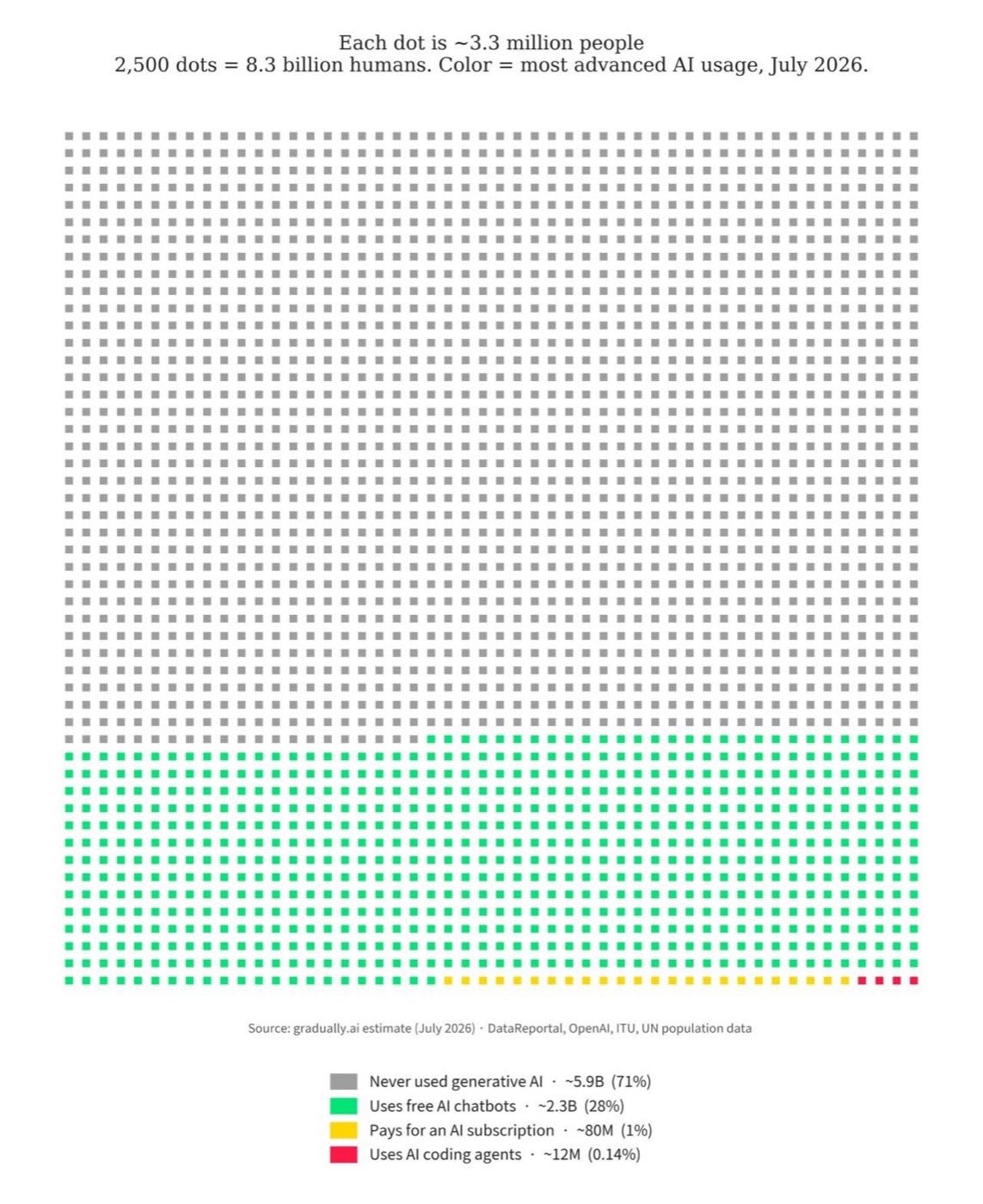
Most of the page is grey. Grey means never touched it. Roughly 5.9 billion people, 71 percent of the planet.
Under that sits a thick band of green. Free chatbots. 2.3 billion, 28 percent.
Then it thins out fast. A short yellow line runs along the bottom: people who pay for AI, 80 million, 1 percent.
At the very end there are four red dots. People running AI agents, the kind that go do work. 12 million, 0.14 percent. Four dots hold the entire category.
Those figures are an estimate, not a census. I would not lean on the decimals, but the shape holds up.
Everyone argues about the wrong part of the chart
The conversation online is always about the grey. Will AI take jobs, and are the 71 percent falling behind.
That argument skips the steepest part of the page.
Green to yellow is 2.3 billion down to 80 million, a 97 percent drop to get someone to pay for it. Yellow to red is 80 million down to 12 million, and another 85 percent disappears.
Using AI is ordinary now. More than 1 in 4 people on earth have typed something into a chatbot.
The rare thing is getting AI to finish a job you did not sit and watch.
What the red dots have
I run my whole business this way. A Tuesday when I am not at my desk looks like this.
Every thirty minutes, 7am to 10pm, something on an always-on machine reads my inbox. It sorts it, flags what needs me, and writes the replies I would write. It never sends. I press send.
My follow-ups run on a rhythm. People I owe a check-in get one drafted before I remember I owe them.
Twice a day, morning and around 7:30 at night, a job works through car auction listings, scores what is there, and texts me five lines.
At 10:30 every night, another job compares what it wrote for my newsletter against what I published after editing it. It reads my corrections, and next week's draft lands closer.
I am not in any of that. I am at lunch.
The line is whether you are in the room
A chatbot is a conversation. You show up, you ask, it answers, it forgets you.
An agent is a job. You define it once and it runs whether you are there or not.
That is the line between green and red, and it explains why the drop is so steep. Crossing it takes a different question.
Green asks what this thing can tell me. Red asks what I never want to touch again.
Most people never get to the second one. Nobody told them it was on the table.
Why it is mostly programmers so far
Look at the legend on that chart again. The red tier is labeled AI coding agents, and that label explains the whole shape.
Those 12 million are almost all developers, because developers were the first people handed tools that could go execute something. The capability showed up in their world first.
Nothing I described up there is code. It is email, follow-ups, and reading my own edits back to me.
That is every business. The consultant, the agency owner, the guy with a truck and a phone that will not stop ringing.
The capability arrived. The instruction manual went to one industry.
What this means if you are somewhere in the green
If you use a chatbot today you are ahead of 71 percent of humans, which counts for something.
You are also in the part of the chart that is about to get crowded. Everyone gets a chatbot. That stops being an edge soon.
The useful question is this. What did I do this week that I never want to do again?
Pick the smallest and dumbest one, the thing you resent on Thursdays. Build one job that does it while you are asleep, then watch it run for a month before you build a second one.
Consistency over intensity. Same as everything else. One job running every day beats a heroic weekend of setup you abandon by March.
Four dots
I keep coming back to the size of that red line.
Four dots out of 2,500. Print the chart, set it on a table, and you could cover the whole category with your thumbnail.
It will not stay at four. It is the fastest growing band on the page and it is not close.
Right now, today, doing this puts you in a group so small it barely renders. That is a strange thing to be able to say about something you could start this afternoon.
Common Questions
How many people use AI in 2026?
About 2.3 billion people, roughly 28 percent of the world, use free AI chatbots. Around 80 million pay for an AI subscription, and about 12 million use AI agents that carry out work on their own. Roughly 5.9 billion people have never used generative AI at all. Those are estimates built on DataReportal, OpenAI, ITU and UN population data as of July 2026, not a census.
What is the difference between an AI chatbot and an AI agent?
A chatbot is a conversation. You ask it something, it answers, and the exchange ends there. An agent is a standing job. You define it once and it runs on a schedule whether you are at your desk or not, which is why so few people have crossed from one to the other.
Do you have to be a programmer to use AI agents?
No. The 12 million people in that top tier are mostly developers because the tools reached their industry first. The work most business owners want handled is email, follow-up, research and scheduling, none of which is code.
Where should a small business owner start?
Pick the single most repetitive task you did this week and build one job that handles it while you are asleep. Let it run for a month before you add a second one. One reliable job beats five half-finished ones.